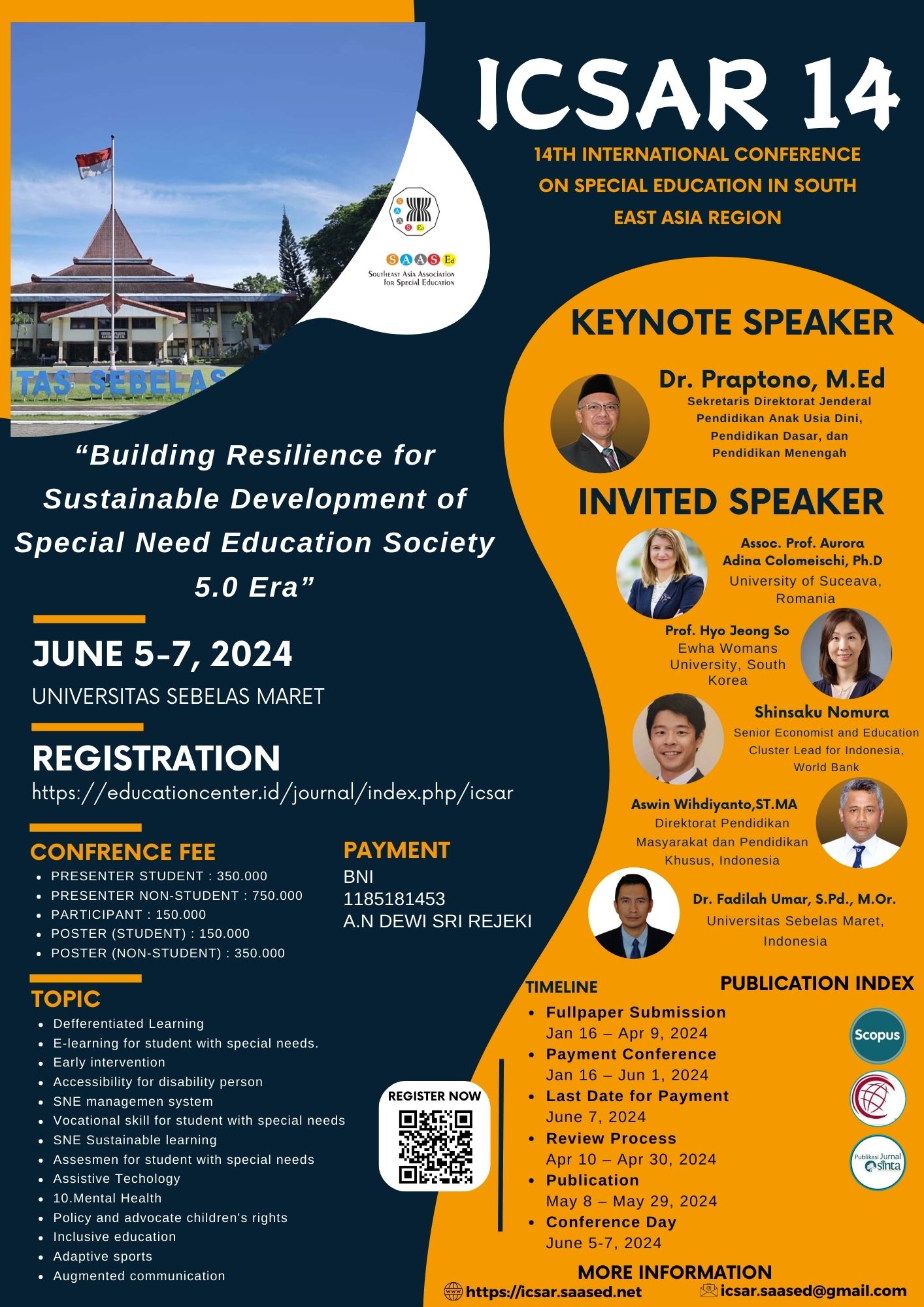
Mapping The Trends of Inclusive Education Research Based on Scopus Database: 2019-2024
DOI:
https://doi.org/10.57142/picsar.v3i1.460Keywords:
inclusive education, bibliometric analysis, scopus database, biblioshiny, vosviewerAbstract
This bibliometric analysis examines current research on inclusive education, identifying key trends, influential authors, and impactful publications. The study analyzed 1,720 articles from the Scopus database, spanning 2019 to 2024. The analysis was conducted using the VosViewer and Biblioshiny software, a web-based application included in the bibliometrics package in R. The findings reveal a consistent upward trend in publications, with Spain, the United States, Australia, the United Kingdom, and South Africa leading the research. The most cited works focus on promoting inclusion, integrating special and inclusive education, and teachers' attitudes. Thematic analysis highlights the growing emphasis on inclusive education, human factors, and technology integration. The study provides valuable insights into the multifaceted nature of inclusive education, underscoring the need for a comprehensive approach to address individual and systemic factors. As the field continues to evolve, this analysis offers a foundation for future research to enhance inclusive educational practices further and ensure equitable access to quality education for all learners.
References
Agbenyega, J. A., & Deku, P. K. (2011). Building new identities in teacher preparation for inclusive education in Ghana. Current Issues in Education, 14(1).
Ajuwon, P. M. (2008). Inclusive education for students with disabilities in nigeria: Benefits, challenges and policy implications. International Journal of Special Education, 23(3), 12–17. https://www.scopus.com/inward/record.uri?eid=2-s2.0-
&partnerID=40&md5=98fc03fbde34c5f096484b16c4586762
Alhakim-Irene, L.-D. H.-S., & Nadhiroh, M. (2019). Pengukuran kinerja riset: Teori dan implementasi.
LIPI. Press, Jakarta.
Alkahtani, K. D. F. (2022). Teachers’ knowledge and attitudes toward sustainable inclusive education for
students with emotional and behavioral disorders. Children, 9(12), 1940. https://doi.org/10.3390/children9121940
Aria, M., & Cuccurullo, C. (2017). Bibliometrix: An R-tool for comprehensive science mapping analysis.
Journal of Informetrics, 11(4), 959–975. https://doi.org/10.1016/j.joi.2017.08.007
Baer, R. M., Daviso, A. W., Flexer, R. W., McMahan Queen, R., & Meindl, R. S. (2011). Students with intellectual disabilities: Predictors of transition outcomes. Career Development for Exceptional Individuals, 34(3), 132–141. https://doi.org/10.1177/0885728811399090
Booth, T. (2009). Keeping the future alive: Maintaining inclusive values in education and society. In Inclusive Education Across Cultures: Crossing Boundaries, Sharing Ideas (pp. 121–136). SAGE Publications Inc. https://doi.org/10.4135/9788132108320.n9
Comarú, M. W., Lopes, R. M., Braga, L. A. M., Batista Mota, F., & Galvão, C. (2021). A bibliometric and descriptive analysis of inclusive education in science education. Studies in Science Education, 57(2), 241– 263. https://doi.org/10.1080/03057267.2021.1897930
Cretu, D. M., & Morandau, F. (2020). Initial teacher education for inclusive education: A bibliometric analysis of educational research. Sustainability, 12(12), 4923. https://doi.org/10.3390/su12124923
Dubyna, M., Popelo, O., Kholiavko, N., Zhavoronok, А., Fedyshyn, M., & Yakushko, I. (2022). Mapping the literature on financial behavior: A bibliometric analysis using the VOSviewer program.
Flexer, R. W., Daviso, A. W., Baer, R. M., McMahan Queen, R., & Meindl, R. S. (2011). An epidemiological model of transition and postschool outcomes. Career Development for Exceptional Individuals, 34(2), 83–94. https://doi.org/10.1177/0885728810387922
Frake, E., Dean, M., Huynh, L. N., Iadarola, S., & Kasari, C. (2023). Earning your way into general education: Perceptions about autism influence classroom placement. Education Sciences, 13(10). https://doi.org/10.3390/educsci13101050
Hanur, B. S., & Avif, S. (2018). Melayani dengan hati: Menghapus diskriminasi dan segregesi antara anak reguler dengan anak berkebutuhan khusus melalui sekolah inklusif YBPK Kota Kediri. Jurnal Al-Hikmah, 6(1), 27–40.
Hariri, H., Perdana, R., & Putra P, H. R. (2023). Quality management of inclusive schools: A case study in a city in lampung province on the Indonesian island of Sumatra. Educational Administration: Theory and Practice, 29(1), 198–208. https://doi.org/10.17762/kuey.v29i1.533
Hehir, T., Grindal, T., Freeman, B., Lamoreau, R., Borquaye, Y., & Burke, S. (2016). A summary of the evidence on inclusive education. Abt Associates.
Hernández-Torrano, D., Somerton, M., & Helmer, J. (2022). Mapping research on inclusive education since Salamanca Statement: a bibliometric review of the literature over 25 years. International Journal of Inclusive Education, 26(9), 893–912. https://doi.org/10.1080/13603116.2020.1747555
Hsiao, H., Chang, C., Lin, C., Chen, B., Wu, C., & Lin, C. (2016). The development and evaluation of listening and speaking diagnosis and remedial teaching system. British Journal of Educational Technology, 47(2), 372–389. https://doi.org/10.1111/bjet.12237
Humaira, M. A., Prasetyo, T., Hasnin, H. D., & Rachmadtullah, R. (2023). Teacher perceptions of inclusive education training: Implementation of an inclusive elementary school mentoring program based oncollaborative partnership. Journal of Education and E-Learning Research, 10(4), 682–688. https://doi.org/10.20448/jeelr.v10i4.5054
Jacob, U. S., & Olisaemeka, A. N. (2016). Inclusive education in the 21st century: Parameters and opportunities for learners with special needs. European Scientific Journal, ESJ, 12(10), 188. https://doi.org/10.19044/esj.2016.v12n10p188
Kavkler, M., Babuder, M. K., & Magajna, L. (2015). Inclusive education for children with specific learning difficulties: Analysis of opportunities and barriers in inclusive education in Slovenia. Center for Educational Policy Studies Journal, 5(1), 31–52.
Kefallinou, A., Symeonidou, S., & Meijer, C. J. W. (2020). Understanding the value of inclusive education and its implementation: A review of the literature. PROSPECTS, 49(3–4), 135–152. https://doi.org/10.1007/s11125-020-09500-2
Kenny, N., McCoy, S., & O’Higgins Norman, J. (2023). A whole education approach to inclusive education: An integrated model to guide planning, policy, and provision. Education Sciences, 13(9). https://doi.org/10.3390/educsci13090959
Ketenoğlu Kayabaşı, Z. E. (2020). Teachers’ opinions on inclusive education. International Journal of Psychology and Educational Studies, 7(4), 27–36. https://doi.org/10.17220/ijpes.2020.04.003
Khalid, M., & Anjum, G. (2019). Use of remedial teaching approaches for dyslexic students: Experiences of remedial teachers working in urban Pakistan. Cogent Psychology, 6(1). https://doi.org/10.1080/23311908.2019.1580181
Komalasari, M. D., Pamungkas, B., Wihaskoro, A. M., Jana, P., Bahrum, A., & Khairunnisa, N. Z. (2019). Interactive multimedia based on multisensory as a model of inclusive education for student with learning difficulties. Journal of Physics: Conference Series, 1254(1), 012057. https://doi.org/10.1088/1742- 6596/1254/1/012057
Kumar, R., & Chaturvedi, S. (2014). Effectiveness of computer assisted instructional package as remedial teaching for learning disabled children. Learning Community-An International Journal of Educational and Social Development, 5(2and3), 163. https://doi.org/10.5958/2231-458X.2014.00016.5
Kurth, J. A., Miller, A. L., Toews, S. G., Thompson, J. R., Cortés, M., Dahal, M. H., de Escallón, I. E., Hunt,
P. F., Porter, G., Richler, D., Fonseca, I., Singh, R., Šiška, J., Villamero, R., & Wangare, F. (2018). Inclusive education: Perspectives on implementation and practice from international experts. Intellectual and Developmental Disabilities, 56(6), 471–485. https://doi.org/10.1352/1934-9556-56.6.471
Linh, P. H. T., & Azar, A. S. (2019). A comparative study of the inclusive education policy in Vietnam and Malaysia: Proposed solutions for sustainable development education in Vietnam. Education Quarterly Reviews, 2(3). https://doi.org/10.31014/aior.1993.02.03.86
Moberg, S., Muta, E., Korenaga, K., Kuorelahti, M., & Savolainen, H. (2020). Struggling for inclusive education in Japan and Finland: teachers’ attitudes towards inclusive education. European Journal of Special Needs Education, 35(1), 100–114. https://doi.org/10.1080/08856257.2019.1615800
Mumford, V. E., & Chandler, J. P. (2009). Strategies for supporting inclusive education for students with disabilities. Strategies, 22(5), 10–15. https://doi.org/10.1080/08924562.2009.10590834
Nepal, S., Walker, S., & Dillon-Wallace, J. (2024). How do Australian pre-service teachers understand differentiated instruction and associated concepts of inclusion and diversity? International Journal of Inclusive Education, 28(2), 109–123. https://doi.org/10.1080/13603116.2021.1916111
Nurwan, T. W. (2019). Implementasi kebijakan pendidikan inklusif di sekolah dasar. JESS (Journal of Education on Social Science), 3(2), 201–212.
Nyroos, M., Jonsson, B., Korhonen, J., & Eklöf, H. (2015). Children’s mathematical achievement and how it relates to working memory, test anxiety and self-regulation: A person-centred approach. Education Inquiry, 6(1). https://doi.org/10.3402/edui.v6.26026
Osuna-Juárez, A., & González-Castellano, N. (2023). Understanding professors’ and students with disabilities’ perceptions of inclusive higher education: a systematic literature review. European Journal of Special Needs Education. https://doi.org/10.1080/08856257.2023.2294238
Page, M. J., McKenzie, J. E., Bossuyt, P. M., Boutron, I., Hoffmann, T. C., Mulrow, C. D., Shamseer, L., Tetzlaff, J. M., Akl, E. A., Brennan, S. E., Chou, R., Glanville, J., Grimshaw, J. M., Hróbjartsson, A., Lalu,
M. M., Li, T., Loder, E. W., Mayo-Wilson, E., McDonald, S., … Moher, D. (2021). The PRISMA 2020 statement: An updated guideline for reporting systematic reviews. BMJ, n71. https://doi.org/10.1136/bmj.n71
Pritchard, A. (1969). Statistical bibliography or bibliometrics. Journal of Documentation, 25, 348.
Roemer, R. C., & Borchardt, R. (2015). Meaningful metrics: A 21st century librarian’s guide to bibliometrics,
altmetrics, and research impact. Amer Library Assn.
Royani, Y., & Idhani, D. (2018). Analisis bibliometrik jurnal marine research in Indonesia. Media Pustakawan, 25(4), 60–65.
Sahrudin, M., Djafri, N., & Suking, A. (2023). Pengelolaan pendidikan inklusif. Jambura Journal of Educational Management, 162–179.
Selenius, H., & Ginner Hau, H. (2023). A scoping review on the psychometric properties of the teacher efficacy for inclusive practices (TEIP) scale. Scandinavian Journal of Educational Research. https://doi.org/10.1080/00313831.2023.2185811
van Eck, N. J., & Waltman, L. (2010). Software survey: VOSviewer, a computer program for bibliometric mapping. Scientometrics, 84(2), 523–538. https://doi.org/10.1007/s11192-009-0146-3
Wijaya, A. (2018). Analisis bibliometrik: Peta konsep, trend, dan peluang riset. Lecturer Notes in Health Science.
Yasin, M. H. M., Susilawati, S. Y., Tahar, M. M., & Jamaludin, K. A. (2023). An analysis of inclusive education practices in East Java Indonesian preschools. Frontiers in Psychology, 14. https://doi.org/10.3389/fpsyg.2023.1064870
Yuwono, I., & Mirnawati, M. (2021). Strategi pembelajaran kreatif dalam pendidikan inklusi di jenjang sekolah dasar. Jurnal Basicedu, 5(4), 2015–2020. https://doi.org/10.31004/basicedu.v5i4.1108
Downloads
Published
How to Cite
Issue
Section
License
Copyright (c) 2024 Proceeding of International Conference on Special Education in South East Asia Region

This work is licensed under a Creative Commons Attribution 4.0 International License.