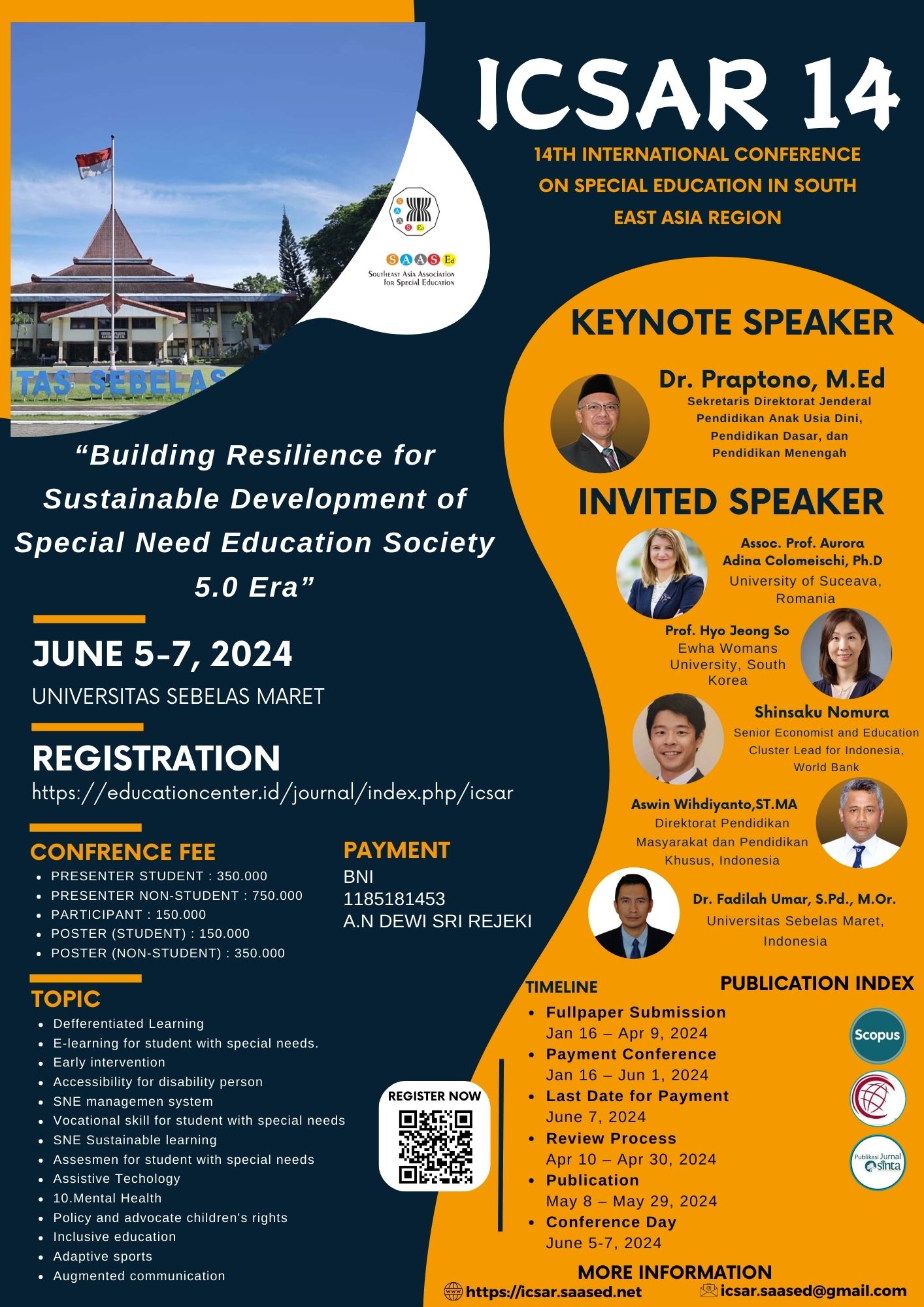
Collaborative Education Issues in Indonesia
DOI:
https://doi.org/10.57142/picsar.v3i1.506Keywords:
Education collaboration, inclusion, education policyAbstract
Education issues Collaboration in Indonesia includes lack, lack of connections between teachers, professionals, schools, parents and social stigma towards students with special needs. So from improved teacher training, increased understanding of parents, schools, and campaigns to change the perception of society. The importance of educational policies that support collaborative inclusion. Through the cooperation of governments, educational institutions, experts/professionals, teachers, parents, and the community, collaborative education can be realized. The vision of inclusion is to provide quality education to all students, without discrimination. This collaboration enables every student, including those with special needs, to reach their full potential in an inclusive and supportive environment.
References
Cross, L., & Walker-Knight, D. (1997). Inclusion: Developing collaborative and cooperative school communities. Educational Forum, 61(3), 269–277. https://doi.org/10.1080/00131729709335264
Florida USF Tampa Graduate Theses, S., USF Graduate Theses, D., & Emin Ozturk, M. (2017). Collaboration with Families: Perceptions of Special Education Collaboration with Families: Perceptions of Special Education Preservice Teachers and Teacher Preparation Preservice Teachers and Teacher Preparation Part of the Special Education and Teaching Commons Scholar Commons Citation Scholar Commons Citation. https://digitalcommons.usf.edu/etd
Gall, B. A. (2007). Being There is Not Enough: Inclusion is both Deaf and Hearing. Deafness and Education International, 9(4), 171–172. https://doi.org/10.1002/dei
Hansen, J. H., Carrington, S., Jensen, C. R., Molbæk, M., & Secher Schmidt, M. C. (2020a). The collaborative practice of inclusion and exclusion. Nordic Journal of Studies in Educational Policy, 6(1), 47–57. https://doi.org/10.1080/20020317.2020.1730112
Hansen, J. H., Carrington, S., Jensen, C. R., Molbæk, M., & Secher Schmidt, M. C. (2020b). The collaborative practice of inclusion and exclusion. Nordic Journal of Studies in Educational Policy, 6(1), 47–57. https://doi.org/10.1080/20020317.2020.1730112
Holmqvist, M., & Lelinge, B. (2021a). Teachers’ collaborative professional development for inclusive education. European Journal of Special Needs Education, 36(5), 819–833. https://doi.org/10.1080/08856257.2020.1842974
Holmqvist, M., & Lelinge, B. (2021b). Teachers’ collaborative professional development for inclusive education. European Journal of Special Needs Education, 36(5), 819–833. https://doi.org/10.1080/08856257.2020.1842974
Knackendoffel, A., Dettmer, P., & Thurston, L. P. (n.d.). Collaborating, consulting, and working in teams for students with special needs.
Knackendoffel, A., Dettmer, P., & Thurston, L. P. (2020). Collaborating, consulting, and working in teams for students with special needs.
Kolawole, O. D., & Pusoetsile, T. (2022). What difference does literacy make among adult learners? Impact of adult basic education programme in a rural community in Botswana. Journal of Adult and Continuing Education, 28(1), 227–251. https://doi.org/10.1177/14779714211007495
Komesaroff, L. R. (2006). Being There is Not Enough : Inclusion is both Deaf and Hearing. 8(2), 88–100. https://doi.org/10.1002/dei
Kramer, L. A., & Fask, J. F. (2016). Creative Collaborations through Inclusive Theatre and Community Based Learning STUDENTS IN TRANSITION. http://www.springer.com/series/14603
Marston, D., & Heistad, D. (n.d.-a). ASSESSING COLLABORATIVE INCLUSION AS AN EFFECTIVE MODEL FOR THE DELIVERY OF SPECIAL EDUCATION SERVICES.
Marston, D., & Heistad, D. (n.d.-b). ASSESSING COLLABORATIVE INCLUSION AS AN EFFECTIVE MODEL FOR THE DELIVERY OF SPECIAL EDUCATION SERVICES.
McLain, M. (2019). Developing perspectives on ‘the demonstration’ as a signature pedagogy in design and technology education. International Journal of Technology and Design Education, 0123456789. https://doi.org/10.1007/s10798-019-09545-1
Messiou, K. (2019a). Collaborative action research: facilitating inclusion in schools. Educational Action Research, 27(2), 197–209. https://doi.org/10.1080/09650792.2018.1436081
Messiou, K. (2019b). Collaborative action research: facilitating inclusion in schools. Educational Action Research, 27(2), 197–209. https://doi.org/10.1080/09650792.2018.1436081
Mulholland, M., & O’Connor, U. (2016a). Collaborative classroom practice for inclusion: perspectives of classroom teachers and learning support/resource teachers. International Journal of Inclusive Education, 20(10), 1070–1083. https://doi.org/10.1080/13603116.2016.1145266
Mulholland, M., & O’Connor, U. (2016b). Collaborative classroom practice for inclusion: perspectives of classroom teachers and learning support/resource teachers. International Journal of Inclusive Education, 20(10), 1070–1083. https://doi.org/10.1080/13603116.2016.1145266
Salvia, John., Ysseldyke, J. E., & Bolt, Sara. (2010a). Assessment in special and inclusive education. Wadsworth/Cencage Learning.
Salvia, John., Ysseldyke, J. E., & Bolt, Sara. (2010b). Assessment in special and inclusive education. Wadsworth/Cencage Learning.
Smith, R., & Leonard, P. (2005a). Collaboration for inclusion: Practitioner perspectives. Equity and Excellence in Education, 38(4), 269–279. https://doi.org/10.1080/10665680500299650
Smith, R., & Leonard, P. (2005b). Collaboration for inclusion: Practitioner perspectives. Equity and Excellence in Education, 38(4), 269–279. https://doi.org/10.1080/10665680500299650
Solari, E. (2014). Longitudinal prediction of 1st and 2nd grade English oral reading fluency in ELL. Journal of Adolescence, 74(4), 274–283. https://doi.org/10.1002/pits
Thomson, C. (2013a). Collaborative consultation to promote inclusion: Voices from the classroom. In International Journal of Inclusive Education (Vol. 17, Issue 8, pp. 882–894). https://doi.org/10.1080/13603116.2011.602535
Thomson, C. (2013b). Collaborative consultation to promote inclusion: Voices from the classroom. In International Journal of Inclusive Education (Vol. 17, Issue 8, pp. 882–894). https://doi.org/10.1080/13603116.2011.602535
Thyan, P. H. (2019). Basic Needs: Literacy, Education, and Communicative Relationships. Jadara, 12(4), 24.
Downloads
Published
How to Cite
Issue
Section
License
Copyright (c) 2024 Proceeding of International Conference on Special Education in South East Asia Region

This work is licensed under a Creative Commons Attribution 4.0 International License.